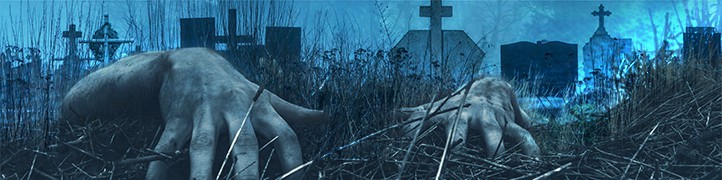

Intensity 🩸 out of 🩸🩸🩸🩸🩸
Directed by Nicholas Pineda.
Let’s get the positives out of the way. Infirmary has one hell of a poster. The design is clean, clear, and perfectly emblematic of a medical setting gone wrong. Second is the aforementioned setting. The abandoned hospital that was used for the film is near-perfect. It’s eerie, run down, and you could easily see ungodly experiments taking place there.
Finally, Infirmary has a tight run time. It’s fairly short and concise at one hour and 27 minutes. As many films in the modern era are inching towards two hours plus, or even worse, nine hour-long serials, it’s nice to see a film that’s economical.
Now that the positives are out of the way, let’s get to the problems with infirmary. First and foremost, this found footage film isn’t scary. There’s maybe one-ish jump scares and the film does noting with its exceptional set.
The film boorishly follows a young security guard Edward (Paul Syre Lee) who’s on the first night of a job at an abandoned nut house that’s set to be demolished in the coming days. Edward, or as his supervisor Lester (Mark Anthony Williams) likes to say, Ed, is a former Marine who’s working his way back in to society after several tours in Afghanistan.
Lester informs Ed that he just needs to keep the facility secure from tweakers and follow his orders. Lester also causally discloses the fact that the hospital was run by a family who conducted horrifying experiments on its patients. Even more weird is the fact that the wife of the deceased head doctor goes mad and dedicates herself to transferring the minds of the patients into mannequins.
Even more weird than that? There may have been some witchcraft, dark arts, or black magic involved!
That brings us to problem number two. None of the items mentioned above are further explored or even illustrated in the film. No bloody rituals. No hint of black magic. Not even a wiff of the Dark Lord. Sure there’s some odd mannequin that shows up a handful of times and spooks Edward, but that’s about it. No further exposition. No unpacking the hospital’s secrets.

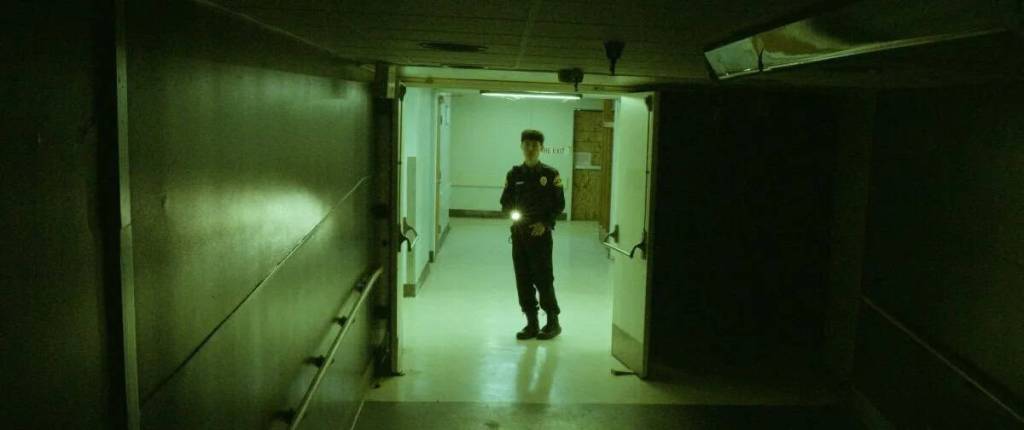
Problem three. As a found footage film it just isn’t scary. There’s a couple instances of things in the shadows that turn out to be a local tweaker who broke into the facility, but even the jump scares are ho-hum at best. They do provide reasonable explanation for the body cameras and the security cameras, but at the end of the day it doesn’t really matter.
The last problem with the film is that the director, Nicholas Pineda, didn’t really end up using all of the cool, creepy, and off-putting hospital wares at his disposal. There were piles of old records, surgical rooms, and impossibly long and dark corridors, but Edward simply wandered around them — and NOTHING happened.
Should you see Infirmary?
At the Scariest Things Podcast, we always root for the underdog and encourage small independent films to keep on keeping on. However, in this case, we’re here to tell you that it’s OK to stay away from this latest Shudder offering. The creepy old “Wilshire Hospital” in Los Angeles deserves better than Infirmary — much better.
That’s probably the biggest disappointment with the film is that they simply wasted such a cool set. I can only imagine the difficulty with obtaining the permits and permissions to film at at facility like this, so it’s even doubly frustrating when little to nothing comes of it.
There are many films of this ilk. Ghost hunters in mausoleums, film crews at abandoned mental institutions, and even the exceptional, Last Shift follows similar themes and tropes. But be warned, horror hounds, Infirmary is not worth your time.
Infirmary is probably a strong PG-13 and streaming on Shudder.