

Intensity: 🩸🩸1/2 out of 🩸🩸🩸🩸🩸
Written and Directed by Taratoa Stappard
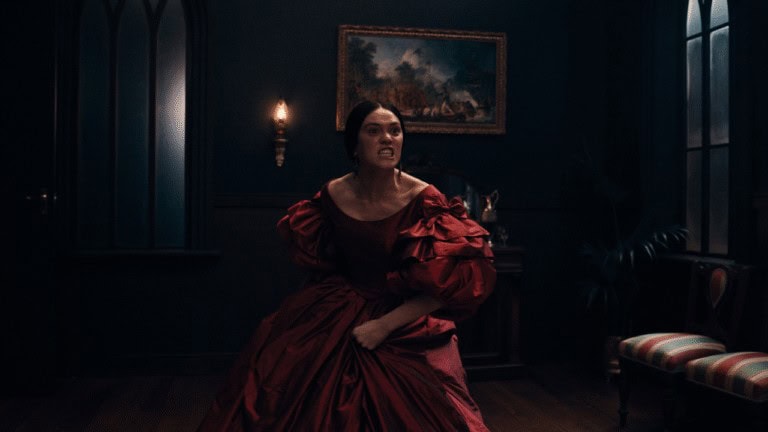
Mārama brings the cultural heft of colonialism to a stunning-looking Gothic revenge-horror story. Add on a layer of creepy misogyny and a ghostly touch, and you have a fist-pump-worthy event. Ariana Osborne brings a visceral rage to a Māori warrior forced into a Victorian ball gown. She is defiance incarnate. If you like your horror to come with a message, embrace this film.
If you combined Jane Eyre (2011), The Piano (1993), Moby Dick, and Once Were Warriors (1994), you might end up with something like Mārama. Fortunately, you don’t have to imagine it, as it has been skillfully executed already by Taratoa Stappard and his brilliant cast. Though festooned with Victorian trim, modern themes power the story. Coursing through its dramatic veins are women’s liberation, cultural appropriation, and colonial oppression. The trappings show the limits on what a young woman could do in that conservative era, which makes the contrast with our heroine’s actions even more powerful.
To be clear, though the messages are directly stated, they aren’t ham-fisted. The art direction, choreography, and wonderful costumes frame the themes. The cast feels cut from BBC cloth. The performances range from muddy whispers to roaring bravado. The film’s main issue is that it isn’t always clear where the movie takes place, and it’s hard to identify who some of the cast members are.
The Cast of Mārama:
- Ariana Osborne plays Mary Stevens, a Māori woman who travels across the ocean to learn who her parents are after receiving a letter from an old sailor. A British family in New Zealand raised the orphaned Mary. Unfortunately, she never knew her parents.
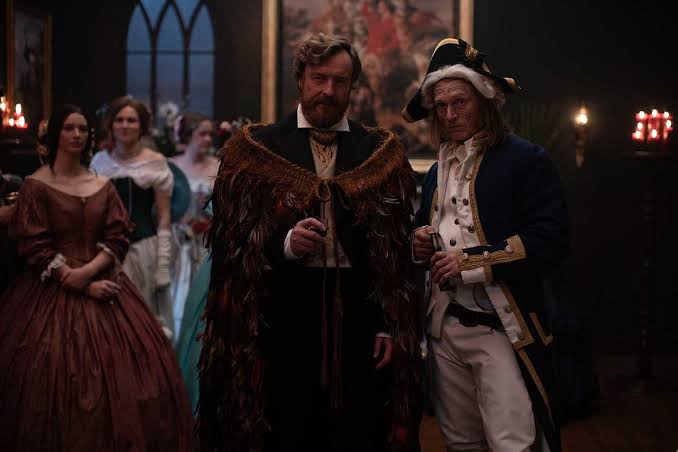
- Toby Stephens plays Nathanial Cole, a successful whaler turned aristocrat. He has an obsessive fondness for Maori culture and has become a collector of Polynesian artifacts. His thin veneer of sophistication and politeness hides a brutal background.
- Erroll Shand plays Jack, a rough companion and old mate of Cole. He too was a whaler who has adorned himself with Polynesian tattoos and learned the Maori language, but it is clear that he’s an appropriator with little regard for the indigenous culture.
- Evelyn Towersy plays Anne Cole, Nathaniel’s young granddaughter. Cole wishes Mary to be her governess, and Anne is eager to be with Mary. Anne is innocent and unaware of her father’s complicated history.
- Umi Myers plays Peggy, Cole’s housemaid. Peggy keeps an emotional distance from Mary. She resents Mary’s ability to escape the laboring class that Peggy is stuck in.
- Jordan Mooney plays Arthur Cole, Nathan’s adult son, still grieving the loss of his wife, Emilia. Arthur bears the family’s sins and became a drunken layabout as a result. He loves his little sister and will do much to protect her.
A Synopsis of Mārama:
The Year is 1859, and we follow a horse and carriage rattling down an English seaside road. Aboard is Mary, a young woman seeking answers about her lineage. A man named Thomas Boyd had written to her, claiming he knew who her real parents were, but she needed to come to England for the details. She arrives at Boyd’s house, but it is an empty hovel. Confused and alone, Mary finds herself stranded in a strange land. Peggy, a servant to the manor lord of the area comes to pick Mary up at Nathaniel Cole’s request. He heard that Mary would be arriving. Peggy has arrived to retrieve her.
Nathaniel warmly greets Mary, claiming that he admires so much of Maori culture. His manor, all shrouded in deep blue-green tones mimics his life on the stormy southern seas around New Zealand where he was a whaling entrepreneur. The estate is decorated with signs of imperial prowess and the plunder of whales. Bloody paintings of whale hunts hang on the walls, and rare artifacts of Mary’s culture are proudly displayed. He claims that her arrival is a bit of good luck, as he believes she would make an excellent governess to his young daughter, Anne, who takes an immediate shine to Mary. Mary prefers to return home to New Zealand, but Cole insists that she give the nanny job a try. Despite his outward politeness, there is a shadow of menace behind Cole’s offer.
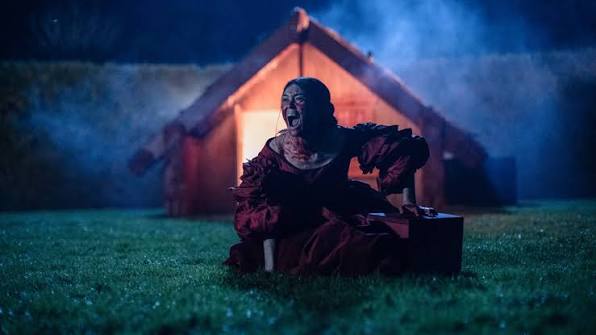
Anne joyfully shows Mary the estate grounds. She takes Mary to her favorite spot, behind a secret garden door. Inside is a wharenui, the traditional house of Maori culture, transported here to be Cole’s most audacious trophy. This shocks Mary to her core. The English have a dubious reputation for sacking and plundering other cultures, and Cole has now done this on a grand scale, and it appears Mary is to be part of his collection.
The Haunt and the Revenge
Mary’s arrival at the wharenui makes her faint, and gives her a vision. She sees a woman, who looks very much like her, singing on the sea shore, but it is in her home of Aoteroa. (New Zealand) When she awakes, she encounters Nathaniel’s compatriot, Jack, who bears the facial tattoos of a Maori man. He is more of a Dickensian rogue, and definitely not Polynesian. Jack has just concluded an unsavory mission for Nathaniel, which will bear immense consequence later in the film. When she takes his hand she is stunned by another vision of the same woman, but this time she is likely dead, bleeding from a series of head wounds. Mary jumps back in revulsion.
“Pleased to meet you…”
Mary
“You don’t sound it.”
Jack
Further exploration of the manor triggers more memories. Every time she encounters a Maori artifact something flashes, faces screaming back at her. Secrets are revealed, she learns her given name is Mārama, and that she had a twin sister, Emilia, who was brought back from New Zealand, and ended up marrying Arthur before she perished under mysterious circumstances. Things come to a head, when Nathaniel announces that he will be having a costume ball to celebrate his birthday, forcing the rage out of Mārama. She counters Jack’s mocking haka dance, with an authentic and furious haka of her own, ending her compliance to Nathanial’s manipulations. It turns out Cole has done her family dirty, and Jack was a participant.
It’s time for some payback.
Evaluation of Mārama
The Production:
This is an emotionally potent movie. It echoes Native American centric movies, like Blood Quantum and Slash Back that celebrate the indigenous cultures. Like Prey, this movie has a magnetic young female lead at its center who can kick some serious ass. But this is a much more politically pointed movie. Mārama almost belongs in a category of one, but the Guatemalan film La Llorona makes similar points in its ghost metaphors, and does it in similarly beautiful fashion. The African diaspora horror tale His House also touches on cutural assimilation struggles in a powerful way. But for Polynesian culture, this is the touchmark.
The allegories and metaphors stack on each other. The Cole estate feels like a museum, which for England has been a bit problematic. Ask Egypt, Greece, China, Ghana, Nigeria, about their cultural treasures housed in the great British museums. At Cole’s big costume party, they celebrate the landing of James Cook in New Zealand (and eventually Australia). Cook is still largely regarded as a hero of the crown, though the aboriginals of Australia and the Maori would beg to differ, as it resulted in the colonialization of their homelands. Cook is to Oceanea to what Columbus and is to the Americas. The world would have been a different place, were it not for the European age of Exploration. So, mesage sent, and message received.
The production values for this small independent film are amazing. I would not be surprised if an Oscar nomination is sent for the costumes. I woudl love to know how historical costume YouTube hero Bernadette Banner would grade to say about these costumes. Marama’s red gown is symbolic and will go down as one of the iconic dresses in horror, if enough people see this movie.The color palette of the movie is like the oil paintings of the era. Dark and moody. The deep sea green echoes the sea, and the depths of Cole’s depravity. Cinematographer Gin Loane manages the lighting and contrast exceptionally well.
Also, the dark, ominous soundtrack from Karl Sölve Steven and Rob Thorn is anachronistic in its modern simplicity. It is, however, very effective. The swirling discordant cellos and bass play very well against the brooding imagery of the film.
The Performances:
Mārama is an empowered final girl for the ages, burdened by cultural expectations and strict social norms, and when it’s time for her to act, she is a powerhouse. Watch out for Ariana Osbourne, she’s fairly new to the scene, but this film has the potential to launch her career in a big way. Also, she has a beautiful singing voice, which she gets to show off as both Emilie and Mary/Marama.
Toby Stephens does not play a mustache twirling villain. Nathaniel Cole is a gentleman on the surface, but Stephens plays him such that you can read his schemes just underneath that veneer. Despite his warm and soothing presentation, his actions speak of something sinister. Creeper vibes hit almost immediately. Mary can sense this, and he practically forces her to subject herself to him. Trigger warnings: Nathaniel may be genteel to Mary, but to Emilie he shows his brutality. Domestic savagery is brutally shown. You may recognize Stephens from his long run as the lead of the popular pirate show Black Sails on Starz.
Erroll Shand may be a familar face to horror fans. He just appeared as the beleagured dad Edgar in Evil Dead Burn. Jack is unnerving, magnetic, and wicked. Shand plays him just right. You know Jack is dangerous from the moment you see him, but Shand slow plays his performance. Jack is a powderkeg of potential bad energy. Once you realize what the gift in the box, the special mission that Nathaniel sent him on, you understand how truly awful this guy is.
The Confusion
What keeps this movie from a five star celebration is that it was difficult to piece the story together. I bought the streaming movie on Prime, and I’m glad I did. Not just because I really like the movie, but also because I needed multiple viewings to get the exact story straight. Chalk this up to awkward editing, and part of it due to a story that jumps back and forth with the visions, and the complex nature of both Mary’s background, and the twisted backstory of the Cole legacy.
Ordinarily I applaud a show, don’t tell method of exposition. Too many times in this movie, however, I wasn’t exactly how these people were related to each other. Where does Arthur fit in this family tree? How does Anne fit into the equation? Is that Cole’s daughter or granddaughter? Or both? How did Thomas Boyd get ahold of Mary, and was he authentic? What happened to him? Is that Marama’s mother, or her grandmother? Who is in this vision, and when did it happen? We get answers to all of these items, but it wasn’t readily apparent to me in the first watch.
It is a tangled web of relationships, and I needed a diagram to keep it all clear. Once I untangled it, I admired it, but you shouldn’t have to go to Chat GPT to find out this information.
Concluding Thoughts
Despite the confusing narrative threads, Mārama is almost certainly going to end up on my top 10 of the year list. I was enthralled with the performances, the set design, the music, and the story… despite its myriad of complexities. Should they have simplified the plot? No. Could they have explained it better? Yes. But, perhaps that’s more on me than it is on the writers and editors. All the information is there, it just was a complicated puzzle, in all dark tones.
This movie was a featured presentation in many of the great genre festivals, including Sitges, Overlook, Fantastic Fest, TIFF, the Calgary Underground, and the Seattle International Film Festival (SIFF), where it won the Grand Jury Prize. It has also been nominated for two Fangoria Chainsaw Awards. It has concluded its run, and now it can be found on Prime, Apple TV, and Fandango at Home. I wish that I had seen this on a big festival screen, but I am glad I own a digital copy because of my need for the clarity. Sadly, this was a non-performer at the box office, as I don’t think it ever got a theatrical release.
Marama is not rated, but it would certainly garner an R rating for gory violence and domestic abuse. Go get yourself a copy, if this type of film intrigues you.