


Intensity 🩸🩸🩸out of 🩸🩸🩸🩸🩸
Directed by Zachary Wigon
Written by Virginia Feito
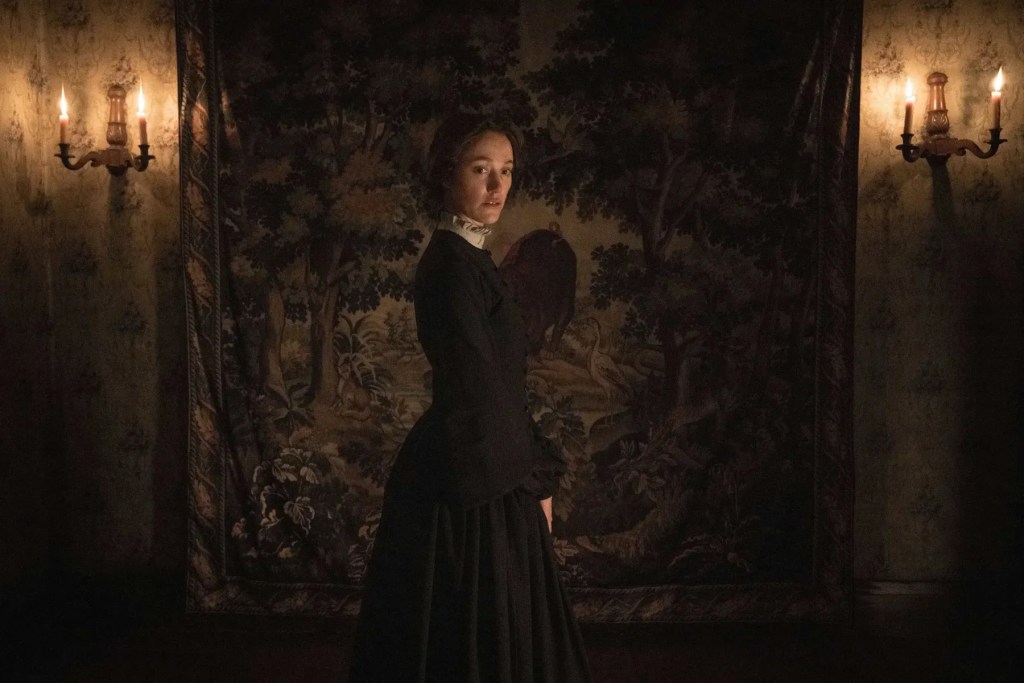
Maika Monroe switches sides from her usual horror-movie heroine role as Winifred Notty in the adventurous and bloody Victorian Psycho (2026). She is the titular Psycho, and she seems to be absolutely relishing the opportunity to be the villain for a change. The film draws on the vast legacy of Victorian class-culture tropes in a proper Upstairs/Downstairs meets Lizzie Borden mashup. There’s never a dull moment in this story, and it uses subtle dark-humor moments to buoy the tone.
“My Name is Winifred Notty, and I am the sanest person I’ve ever met.”
This is our introduction to our protagonist. It’s clear from the odd camera angle, the tilt of Winnifred’s head, and the odd vacant smile on her face that belies her statement. Immediately we are aware that this is a very unreliable narrator, and it automatically sets the game table. Maika Monroe is unquestionably one of the great scream queens of this Golden Age of Horror. Her big breakthrough was as Jay Height, the on-the-run final girl from It Follows (2014). She was one half of a bumbling burglar duo in Villains (2019). Monroe was the paranoid Ambassador’s wife, Julia, in Watcher (2022). And, perhaps in her biggest dramatic performance she starred as Agent Lee Harker in Longlegs (2024). All of these were heroic roles, and she played earnest characters. She was very good in those roles, but they weren’t particularly flashy.
This time she gets to play the creep. These villain roles are always the juiciest. She’s also the central protagonist of this film. This is one of those films that puts the crazy person as the one that you will attach to. In order to assist this bond with the audience, the story is populated with characters, who wile not psychotic sociopaths, are unpleasant people, for the most part. Also, it helps that her mad idiosynchracies are as amusing as they are off-putting. Winnifred is the new Governess for the Pounds family. Her rank places her between the serving staff, but below the landed gentry. She gets a seat at the table, and her own room, but she is most definitely a member of the help.
The Cast of Victorian Psycho
- Maika Monroe plays Winifred Notty, the new Governess at Ensor House, a substantial rural English estate.
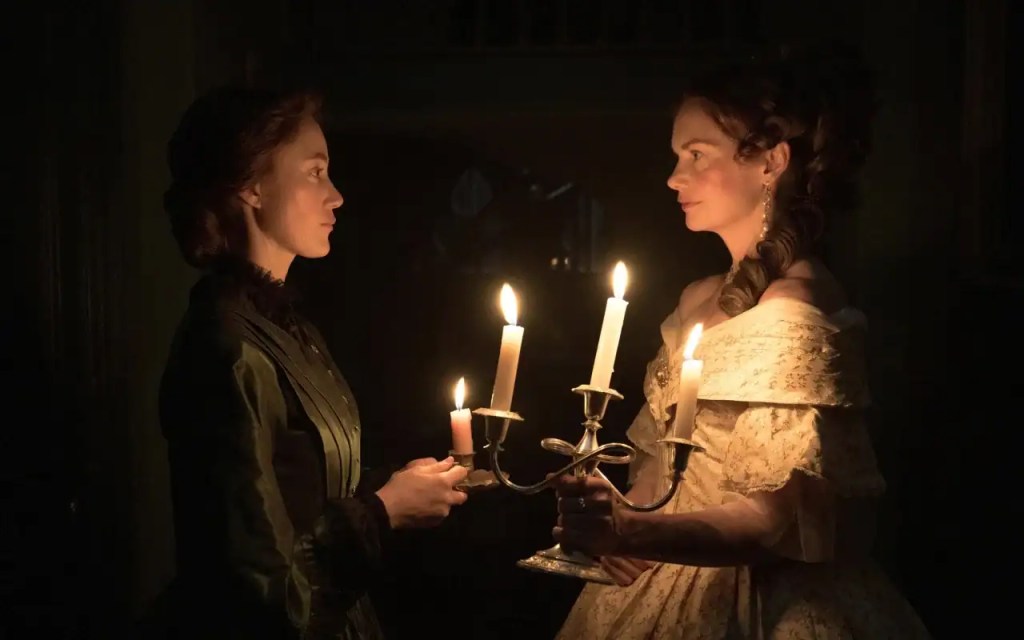
- Thomasin McKenzie plays Ms. Lamb, a housemaid at Ensor House, and Winifred’s only friend.
- Ruth Wilson plays Mrs. Pounds, the stern matriarch of the family.
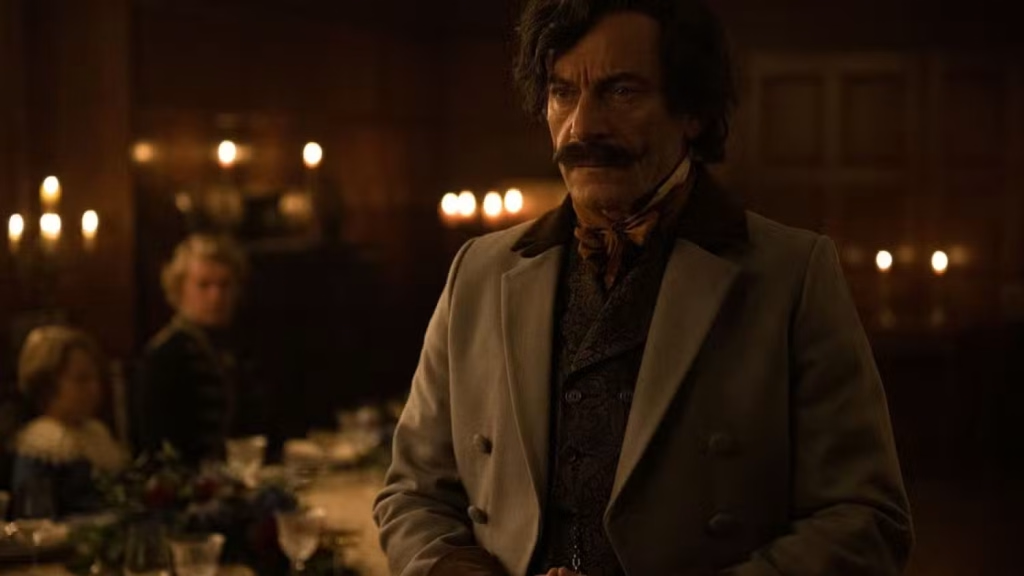
- Jason Isaacs is Mr. Pounds, an eccentric dilettante and the lord of the manor.
- Jacobi Jupe plays Andrew Pounds, the heir of the estate, and is distrustful of the new governess.
- Evie Templeton plays Drusilla Pounds, the older sister, who cautiously absorbs Winifred’s methods.
- Barry O’Connor plays the nosy Gardener, who knows about some of Winifred’s dark secrets.
A Synopsis of Victorian Gothic
Winifred Notty arrives at Ensor House, with an invitation in hand, to become the governess for the two children of the Pounds family. This is a slightly decaying, yet still grand manor, and the same can be said of the family. The Pounds are an eccentric lot, wealthy because John Pounds has amassed a fortune from running factory mills with a bad reputation for child labor exploitation. The Pounds children are wary of their new governess, given the ominous and unexplained disappearance of their previous instructor.
Winifred, eager to become one with the family, quickly launches into lessons in ethics. She instructs Andrew and Drusila that the most important thing to know is the difference between right, wrong, and EVIL. Such irony, since clearly Notty herself struggles with that alignment. Further, she tells them that “The rules of society must ever be maintained.” Also ironic, since she yearns to move up in class. Her first set of lessons ends when the three of them approach a deer lying in the woods. She bludgeons the deer to death with a rock, informing the children that “All creatures are in pain.” What she did was a mercy. (Though the deer most probably was just sleeping.)
The Gardener knows dark secrets about Winifred. There are mysteries about the previous children she had been the governess to, and he has been told that she had something to do with those missing kids. He extorts her for money. Meet him at night, by the barn, or he will tell the parents. She agrees, but comes with an axe under her gown, and butchers the Gardener to keep the secret. Pig food!
So, She’s a Psycho
Nobody discovers the Gardener, but one of the maids, Miss Lamb, sees Winifred sneaking back into the estate, with blood on her dress. Winifred claims she was attacked by a ghoul and that this should remain a secret. Miss Lamb is so frightened that she wants to stay with Winifred, and the two form an unlikely friendship.
More of Winifred’s eccentricities threaten to reveal her madness. She collects trophies from her kills, and that includes the hand of the Gardener and a random ear from someone we don’t know. (Maybe her predecessor? One of her previous charges?) Andrew complains about the lessons, and Drusila has taken to some Victorian pornographic satirical drawings. Mrs. Pounds also suspects her husband of having sex with Winifred. (Not true, but there are worse things afoot.) Yet, Mr. Pounds is fond of her, so she hangs on to her job despite all the tumult.
Winifred carries one big additional secret, and it’s the reason why she wants to be at the manor. A secret so big it will upend everything in the household, and it is a classic Victorian scandal. It’s a big house, with a lot of eyes and ears. Polite Victorian society can repress many a secret, but these are too volatile to remain still for long.
So, Should You See Victorian Psycho?
This is a curious combination of genres that draws from opposite ends of film appreciation. If you are both a fan of slasher horror and also stodgy BBC melodrama dark comedies, then this is your cup of tea! There’s more dramatic tension in the film of the “Will she get caught?” type of drama, as opposed to a jump-scare body count film. And yet, it will get your blood pressure pumping.
First-time feature director Zachary Wigon utilizes a dynamic camera and lavish period sets and costumes. There are some very well-crafted long takes in this movie. Up the stairs, down the hall, into the portrait room. It utilizes Dunsany Castle, Ireland, well. It is the oldest continuously inhabited residence in Ireland, according to Wigon. There are a number of dynamic Raimi-ish tracking shots: Winifred likes to hide evidence by tossing it in the air and swallowing it, and we get to track the object up and down into her gullet. Also, they employ clever through-the-keyhole zoom shots. It’s showy, but I appreciate the style.
Most people associate period piece dramas with being dry and stodgy. This film is active and engaging. The story builds nicely, and the secrets are revealed in a timely manner. The editing is solid. I’m not sure how closely the movie hews to Virginia Feito’s novel, but the plot is built on a solid, deep foundation. It is an assured plot, and populated with colorful characters. It concludes bittersweetly, though consistent with its story mission.
The Performances:
I return to my opening thesis for this film: it is an opportunity to see growth in Maika Monroe’s horror repertoire. She kills it, literally and figuratively. She layers creepy, subtle face acting on top of broad physical performance. Winifred is a sociopath who, despite her lecturing, cannot separate good from evil in her behavior, and it allows the character a measure of blind confidence that a sane person doesn’t have. Moreover, her voice-over narration is breezy and a bit off-kilter. It is one of the best performances from a horror actress this year. Margaret Qualley was originally scheduled for this role, but having seen this, I’m glad it was Monroe.
Jason Isaacs and Ruth Wilson are ideal for their roles as the Pounds. Isaacs is one of cinema’s favorite antagonists, and in this take, he plays it a little on the goofy side. He is probably most famous for playing Lucius Malfoy in the Harry Potter series. He carries that cold, elegant, and sophisticated arrogance like Alan Rickman, Charles Dance, Gary Oldman, and Jeremy Irons. Best at being the bad guy. Those Brits know how to teach their thespians to be sinister.
Wilson is a veteran of the British screen and may be best known to genre audiences for her role as the domineering Mrs. Colter in His Dark Materials. She is regal and stern, and perfectly suited to play the one with the real power in the household.
Thomasin McKenzie, a recognizable movie star receiving second billing, gets lost in the shuffle. Her Miss Lamb is a character who matches her name. She’s meek and passive. It’s a good performance, but her character never really gets fleshed out. The kids hold their own, and I appreciate how Jacobi Jupe performs his bits when he is clearly trying to figure out his next move. Despite his impending power, he is currently fairly powerless.
Concluding Thoughts
When I first learned about this film, I had three points of reference.
- First: They could play it straight, like the Hammer classics.
- Second: It might be an ironically goofy period piece like Pride and Prejudice and Zombies or Abraham Lincoln: Vampire Hunter. Would this movie take itself seriously?
- Third: They go for the grand but stodgy Gothic epic, like The Woman in Black or Crimson Peak.
The answer is that it borrowed from all three options to its benefit. The sets were grand, and the costumes were on point. The lighting felt period and moody; the cinematography was impressive. The movie kept the tone light, and the story never felt like an assignment, which can happen with Victorian dramas. The actors walked the line between serious drama and dark comedy very well.
The popularity of Downton Abbey and The Crown proved to big audiences that you can combine popular contemporary themes within the guise of costume drama. Victorian Psycho injected this formula with copious bloodshed, and I’m down for it.
Victorian Psycho is rated R for strong bloody violence and brief sexual material. It may still be in cinemas, but its box office performance suggests it will be rotated out of multiplexes soon, so keep an eye out for it when it arrives on streaming. Or, if second-run theaters are in your neighborhood, it may likely be there. It’s worth seeing on the big screen if it is still playing near you.
Review by Eric Li