
Directed by Alexandre O. Philippe
Chain Reactions is an incredibly intellectualized love letter to one of the most gruesome films ever laid down on celluloid. Unlike the varied nature of many of Alexandre O. Philippe films — save for Leap of Faith William Friedkin on the Exorcist — the film is a straight forward and linear affair.
Many have opined and re-opined on the Texas Chainsaw Massacre. It’s a film whose brilliance has spawned eight sequels (…depending on who’s counting) and a million also-ran imitators. Some love the film, including Patrick Taggart of the Austin American-Statesman who hailed it as the most important horror film since George A. Romero’s Night of the Living Dead (1968). Some, like Linda Gross of the Los Angeles Times, called it “despicable” and described Tobe Hooper’s story as a “plastic script.”
As horror fans, we all know the truth about the Texas Chainsaw Massacre and the legion of critics who have changed their tune in the intervening decades. No matter your initial thoughts following your first viewing, this is a film that is undeniable and singular in nature. There was no “before” the Texas Chainsaw Massacre — there’s only a blood-soaked and gut-drenched pile of intestines that have been left in its wake. Many have tried to imitate it, but very few (read VERY FEW) have come anywhere close to its singular greatness.
That said, Alexandre O. Philippe film, Chain Reactions, isn’t about editorializing. It’s not about looking at both sides of the coin. It’s not about finding hidden meaning in Leatherface’s wardrobe selections. Quite the opposite. Chain Reactions is about deep and undying exposition about why the film launched such a wild cultural explosion and why the film’s impacts continues across two centuries.
Alexandre O. Philippe carefully selections five individuals to mete out the individual details of their love of the film — comedian Patton Oswalt, director Takashi Miike, film critic Alexandra Heller-Nicholas, writer Stephen King, and director Karyn Kusama.


While each has very distinct views on the film, the two most interesting and synonymous are the bookends of the film comedian Patton Oswalt and director Karyn Kusama. With a focus on the eternal concept of the monster as the “other”, both Oswalt and Kusama have the most poignant perspectives on the film.
In the midst of a compelling comparison and contrast with Nosferatu, Oswalt proffers three fascinating ideas about what really makes the film tick. First and foremost is the connective tissue offered by the sun. From the opening scene with the odd screeches paired with the off-putting solar flares on the face of the sun, to the very end of the film where Leatherface appears to be trying to kill the sun with his chainsaw, it’s the sun that is at the very core of the film.
Oswalt posits that the sun is the element that is slowly driving everyone crazy. Its radiating presence is unstoppable, maddening, and it has managed to burrow its way into the flaccid minds of the entire family.

While many, including Tobe Hooper and writer/produce Kim Henkel, have openly discussed the film’s madness as the perfect metaphor for the slow and unwinding lunacy of the Vietnam War and the pointless and failed Nixon era policies, none of the Chain Reactions interviewees discusses this all-too-obvious point.
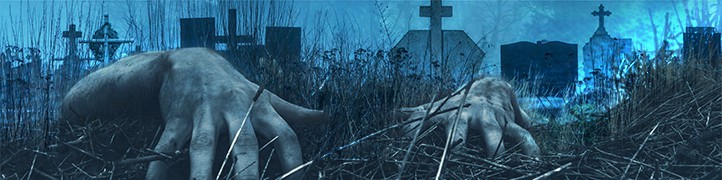
Instead, Oswalt talks about the different, but still adroit allegory, the final throws of westward expansion. Failed capitalism, lack of resources, and scarred landscapes all come together to smother manifest destiny and the American dream. Whether it’s the drunk in the cemetery or the odd-ball that washes the car windows at the gas station, all these characters reflect the ill-fated nature of the attempt to wrestle the west to the ground.
Should you watch Chain Reactions?
No matter your perspective on this film, or whether you were one of the few able to make it past Leatherface’s abduction of Pam in the hallway, this is a film that makes you watch it and watch it closely. Like the worst documentary you’ve ever seen, Texas Chainsaw shows you depravity that’s nearly impossible to run from, and it’s done in a way that lacks all editorial control.
Without commentary, audiences are required to chew on the horror and figure out how to process it on their own. There’s no narration — save for the short bit at beginning of the film. There’s no bothersome exposition dumps. There’s no clumsy character backstories. Texas Chainsaw simply wants you to watch it.
Once again, Alexandre O. Philippe, has created a fascinating look at one of the most enduring films ever made. Like the engrossing nature of all his films, Chain Reactions could have easily been three or four hours long and I wouldn’t have batted an eye. When a documentary leaves you insatiably wanting more, you know that it’s going to stick with you for many a moon.

Chain Reactions is likely Rated R and available in theaters and streaming services everywhere.