

Intensity 🩸🩸🩸 out of 🩸🩸🩸🩸🩸
Directed by Francis Lawrence
Written by JT Mollner and Stephen King
The Long Walk delivers precisely what it promises: a death march competition across the backroads of Americana, where fifty young men look to be the last one standing, where death awaits the rest of the competition. Themes of brotherhood and complacency within an autocratic society are explored. Primarily, however, it’s a pretty thin plot bolstered by a pair of terrific leading young actors.
Francis Lawrence returns to familiar stomping grounds in The Long Walk. The director of The Hunger Games franchise has a long track record with sports as a death game. This time, he is adapting an old Richard Bachman (Stephen King) novel. Needless to say, this time, Lawrence gets to cut loose with the blood bags.
If you have seen the trailer (and if you haven’t, you can check it out below), you will quickly grasp the situation. In an alternate timeline, in what appears to be the late seventies or early eighties, a war has broken out, and an authoritarian regime has made America a land of desperation and poverty. It hasn’t yet gotten to The Hunger Games‘ fantastical societal collapse, but the country has turned to extreme forms of entertainment.
We’ve seen similar entertainment before. Death Race 2000. The Running Man (another Bachman Book). Squid Games. An oppressive government entertains the masses with a combination of blood sport competition and wish-fulfillment prizes. A one in fifty chance to win the lottery? Those aren’t bad odds. The bad news is, if your numbers don’t come up, you are going to be a corpse on the road. And apparently, plenty of boys are willing to make that gamble.
The Cast of The Long Walk
Each of the #’s represents the lottery designation given to the walker.
- Cooper Hoffman plays Raymond Garrity #47, the determined central protagonist.
- David Jonsson plays Peter McVries #23, a charismatic leader of the group.
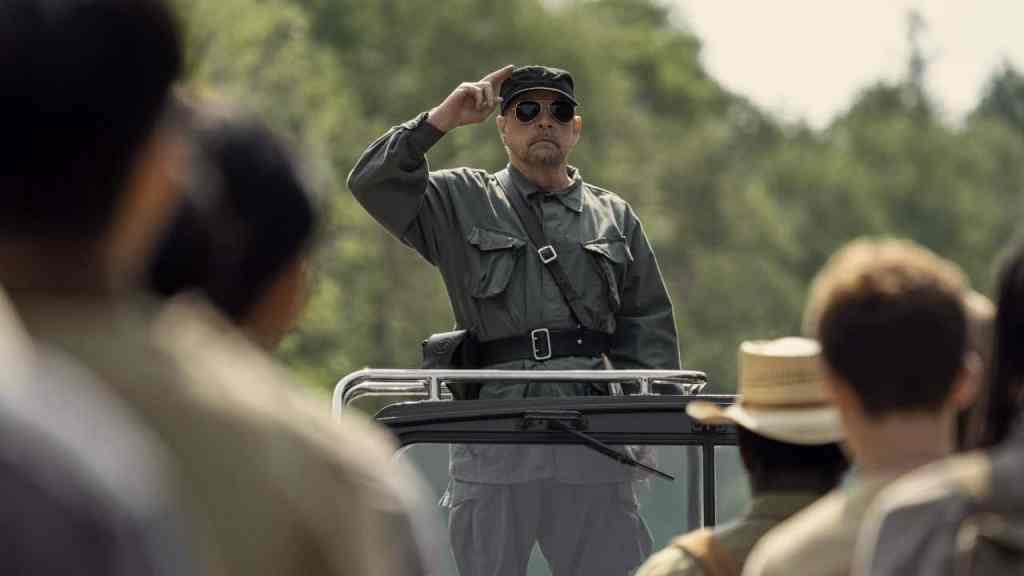
- Mark Hammill plays The Major, the overseer for the Long Walk
- Garrett Wareing plays Stebbins #38, the most physically imposing walker.
- Tut Nyout plays Arthur Baker #6, a lanky Louisiana man who is in it for the money.
- Charlie Plummer plays Gary Barkovitch, #5, who appears cruel and untrustworthy.
- Ben Wang plays Hank Olson #46, a little cocky guy who talks a big game.
- Jordan Gonzalez plays Richard Harkness #49, who wants to document the walk.
- Joshua Odjick plays Collie Parker #48, a loner and a rebel.
- Roman Griffin Davis plays Curly #7, who is probably too young to be on the walk.
- Judy Greer plays Ginnie Garraty, Raymond’s mom.
A Synopsis of The Long Walk
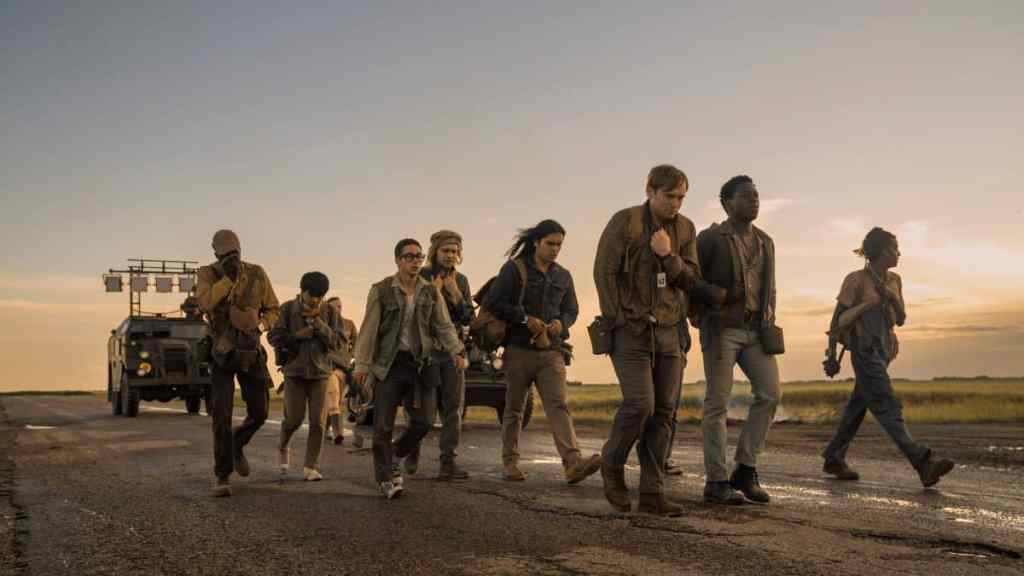
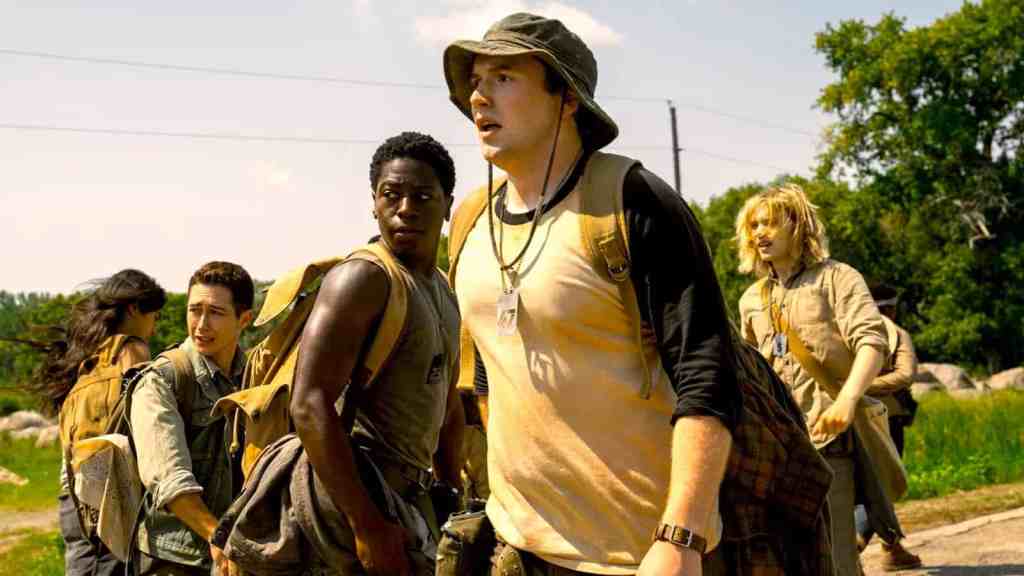
Raymond Garrity arrives at the start of The Long Walk with his mother, who brings him to the starting line at the Northeastern Tip of the country along Highway 1 in Maine. Garrity’s mom tries to talk him out of the journey, but he insists. He can’t back out, anyway. He has been designated by the lottery to participate. This is his home state. The familiarity offers some comfort, but there is only so much that recognition will help him on this death march.
The walkers are assembled at the starting line. A roll call is taken, and each walker is assigned a number from one to fifty, and they receive a pedometer. After a bit of nervous small talk, the Major arrives to announce the start of the race, and he delivers the shorthand version of the rules:
Walk until there is only one of you left.
Maintain a speed of three miles per hour. If you fall below the speed, you will get a warning. If you can’t maintain that speed in ten seconds you will get an additional warning. Three warnings and you get your ticket. Walk one hour at speed and one of your warnings gets erased, and so on. If you go off the pavement you will get your ticket without a warning. There is one winner, and no finish line.”The Major
For the first few miles, the walkers are confident and cocky. Optimism abounds, and the pace isn’t hard, at first. Stories are shared. Relationships are forged. Ray, Pete, Hank, and Baker form a bonding alliance, friends who will support each other through the tougher stretches. The heat and the miles take their toll. Reality hits when the first marcher succumbs to cramps and is cut down as the first sacrifice. The emotional pressure ramps up.
A steeply graded hill provides a culling point for the march in the middle of the night as boys struggle to keep pace. Fellow marchers get tripped up on fallen competitors punching their ticket as well. The remaining familiar faces are pitted against biology (how do you poop?), fatigue (How do you sleep?), and psychological turmoil. Favorites will fall off. Panic sets in. And grand sacrifices will be made until a winner evolves.
Evaluation
The Long Walk is a simple, well-executed story. It oozes Stephen King’s trademark pop-horror tropes: normal people pitted against long odds, with grotesque consequences. If there ever was a railroad plot, this feels like an hourglass timer and a definitive end. One winner. Forty-nine dead losers. And the movie lets you engage with the wide array of personalities, especially between Ray and Pete. The acting chops of Cooper Hoffman (son of the late, great Phillip Seymour Hoffman) and David Jonsson (who also gave a stellar performance in Alien Romulus) are the highlight of the film. Without the conviction of their performances, this would have been a very flat-feeling movie. The characters have plenty of time to exchange philosophies, divulge secrets, and provide a literal shoulder to lean on.
Full credit is due to the entire cast, who had to do long one-take dialogue scenes, walking the whole time. Woe be to the actor who messes up a line, forcing a pause and a reshoot, sending everyone down to the continuity manager (likely the second director) to set it up and do it again. Because Jonsson and Hoffman do much of the dialogue, they get the lion’s share of the credit.
Mark Hamill seems to be reveling in his villainous role. He chews up the scenery with aplomb, his gravelly bark providing the background noise in an otherwise pastoral setting. Surprisingly, he’s not as much of a mustache-twirling baddie as I expected. Villain? Sure. But he’s playing by the rules. He’s lawful evil. The supporting walkers are entertaining, but the dialogue and subplots seem to serve the message. This walk sucks. These boys are doomed. There are several walkers you don’t really meet, but they serve as graphic examples of the evilness of the Long Walk, which is the movie’s weakness.
The Mushy Premise
You have to buy into the premise that society would tolerate blood sport like this. And, for an event that has been run multiple times before, the participants know what they are in for. A painful trek with a bullet in the head is the most likely scenario. Really? This is supposed to be a near-real-world scenario. Even in today’s dysfunctional (but not quite apocalyptic) society, this is a bridge too far. Science fiction, true, but a knowing, voluntary challenge like this stretches credulity.
The walkers, particularly early in the race, boast about how they would use their prize. The prize is nebulous and not clearly defined. Essentially, it’s wish fulfillment. But it never feels like it’s a big enough prize to motivate the marchers. Coming down the stretch with only a few walkers left, too many of the contestants freak out or do something wholly irrational. I’m not talking about the noble sacrifices… and there are a few of those… but the random dash off the road, when dreams were within reach. I understand that it’s all part of the madness, but when the crowd thins, that increases your odds of survival and prosperity. Just saying.
I suggest this is a trope weakness in all death-sport movies. There is a plot rationale to have the big culling in the middle. You can only pay attention to so many characters. Use your redshirts to establish the danger, and then return to your core cast. Aliens did this very well. With The Long Walk, this is the entire premise. It is a reductive diagram with a solitary remainder. I have not read the book, but I hope it provides additional background on why society collapsed so badly. What we see is dust-bowl-like rural poverty along the road, with some haggard locals grimly watching the proceedings. Additional context would have been nice.
Concluding Thoughts
I enjoyed this movie, despite the wonky conceit of the Walk itself. The violence is punchy and creative. You FEEL the grind of the walk, and the length of the movie pushes that sensation. When the movie ends, you have felt the entire march. Granted, the concluding scene is fully foreshadowed in conversations between Ray and Pete. That dialogue arrived with highlighter circles and a spotlight. Yep, that’s how they’re going to end this film, but with one primary variable.
There is a lot of charisma on the screen. Hoffman and Jonssen are stars in the ascendant. Of course, Hamill is already a legend. Ben Wang has already gotten a starring vehicle with the Karate Kid franchise. Charlie Plummer has all the hallmarks of an A24 character actor supreme. But the actor whom I am most intrigued with is Tut Nyuot, whose tall, lanky presence draws the eye. He’s a Brit who can pull off a Creole twang. With the other actors, you can forecast bigger roles. I’m hoping Nyuot gets more great opportunities. (David Jonsson is also a British actor who can pull off a southern accent.)
The Long Walk has concluded its wide theatrical release, but might still be playing in second-run theaters. It’s available to rent and purchase on Amazon Video. The movie is rated R for gore, bodily functions, lots of swearing, and suicide.
Two takeaways: Where are the girls at? Maybe that will be a sequel. As physical competitions go, this is one where female contestants are on even footing. Also, if I ever end up on the long walk, in addition to a comfortable pair of Asics running shoes (velcro, no laces), I’m bringing a roll of toilet paper.